Neurocysticercosis
Neurocysticercosis (NCC) is a parasitic infection of human central nervous system caused by larval form (cysticerci) of zoonotic tapeworm Taenia solium. NCC is considered as an endemic neglected disease that contributes significantly to neurological morbidity/mortality in lower-and middle-income countries (LMIC) of sub-Saharan Africa, Latin America and South-East Asia, but it is being increasingly reported in high-income countries from North-America, Europe and Australia mainly because of migration and traveling.
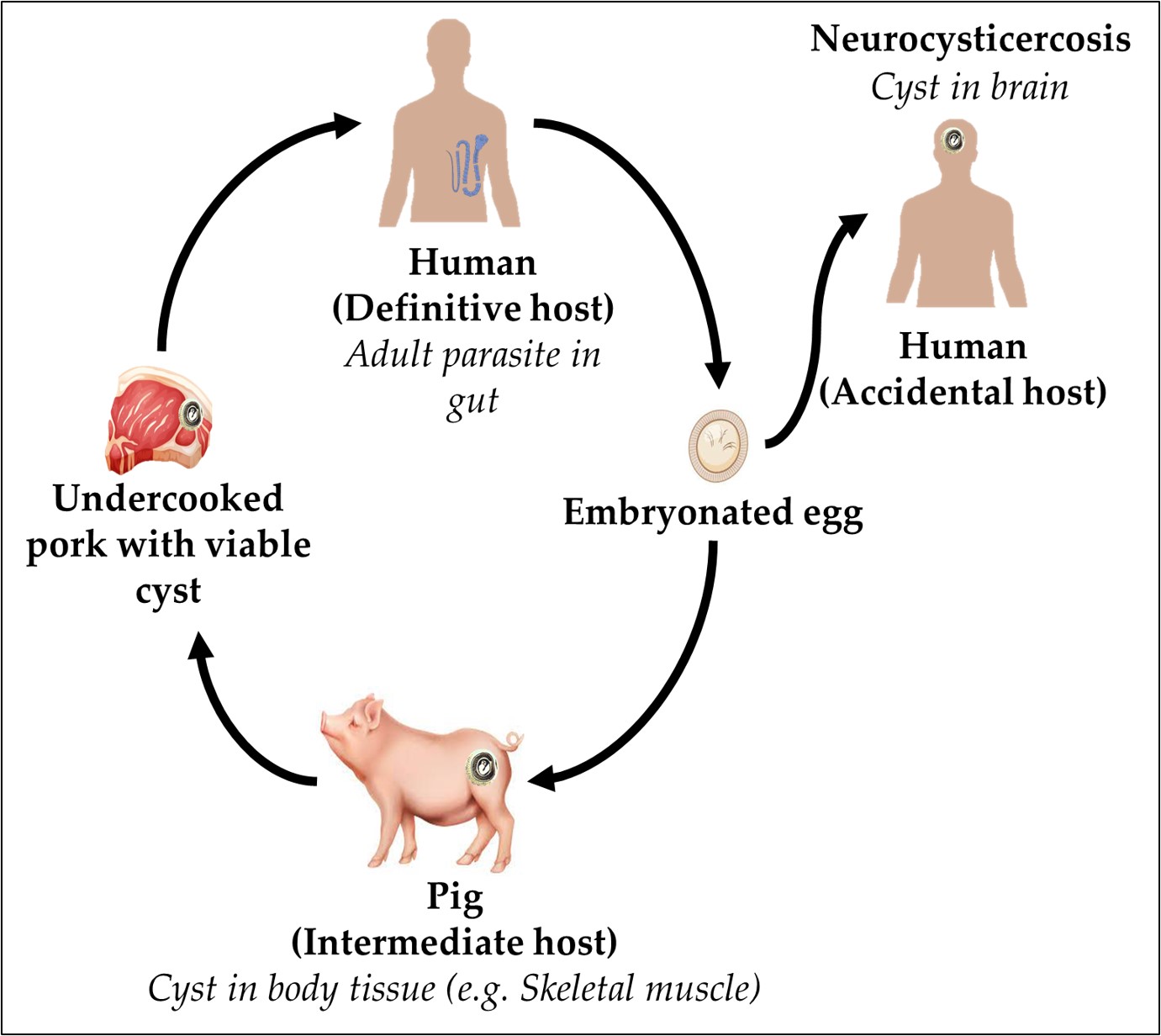
Figure: Life cycle of Taenia solium.
Meta-analysis of proportion studies
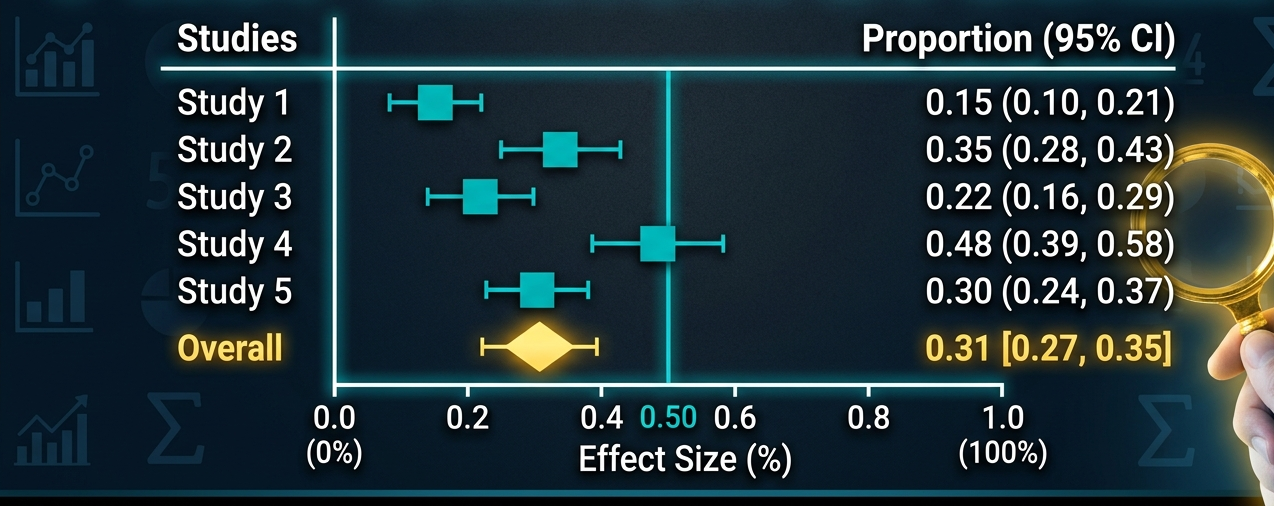
Figure: Forest plot.
Meta-analysis of proportion studies is a statistical approach used to combine prevalence or incidence estimates from multiple studies to generate an overall pooled estimate. It is widely applied in epidemiology and public health research to summarize disease burden, diagnostic accuracy, and population-level outcomes while accounting for variability between studies. Common methods include inverse variance approaches, generalized linear mixed models (GLMM), and Bayesian meta-analysis. I have prepared a learning material focused on inverse variance approaches for researchers and students interested in applied meta-analysis. Click here for details.
Bayesian statistics
Bayesian statistics is a powerful framework for data analysis that combines prior knowledge with observed data to make probabilistic inferences. Unlike traditional statistical methods, which often rely solely on sample data, Bayesian approaches incorporate prior beliefs or existing evidence into the analysis, updating these beliefs as new data becomes available. This method provides intuitive results in the form of probabilities, allowing researchers and decision-makers to quantify uncertainty more clearly. Bayesian statistics is especially useful in fields like medicine, epidemiology, and machine learning, where decisions must often be made with incomplete information. I have prepared an introductory course on Bayesian statistics for beginner and who want to refresh their knowledge. To see the course click here
Bayesian meta-analysis and meta-regression for proportion studies
Recently we have completed a systematic review of literature on frequency of neurocysticercosis (NCC) published between January 01, 1990 to May 06, 2023. The objective of this review was to estimate the updated proportion of NCC among people with epileptic seizure (PWES) and people with neurological manifestations other than seizure. We conducted Bayesian meta-analysis and meta-regression to estimate the pooled proportion of NCC among PWES. The scripts for whole data analysis are available here.
Neurocysticercosis associated Disability-Adjusted Life Years (DALYs)
Neurocysticercosis (NCC), a parasitic infection of the central nervous system caused by the larval form of Taenia solium, is a leading cause of acquired epilepsy globally and contributes significantly to the burden of foodborne diseases in terms of Disability-Adjusted Life Years (DALYs). Although global estimates—such as those from the WHO-FERG and GBD studies—have reported substantial DALYs associated with NCC (e.g., 2.8 million in 2010 and 1.24 million in 2021), these figures primarily account for epilepsy and often overlook other important sequelae like chronic headache. Our research aims to refine these estimates by incorporating a broader range of NCC-related health outcomes, applying country-specific data, and exploring different disease modeling approaches to better capture the true health impact of NCC at national and global levels.
First step of calculating DALYs, is to create a disease model. In our research, we call the disease model as “computational disease model”
“A computational disease model is a schematic framework that links disease biology with the parameters needed for DALY estimation. It defines the mathematical operations connecting incidence, prevalence, mortality, and health loss.”
You can create your disease model using a Shiny App. To try Click here.